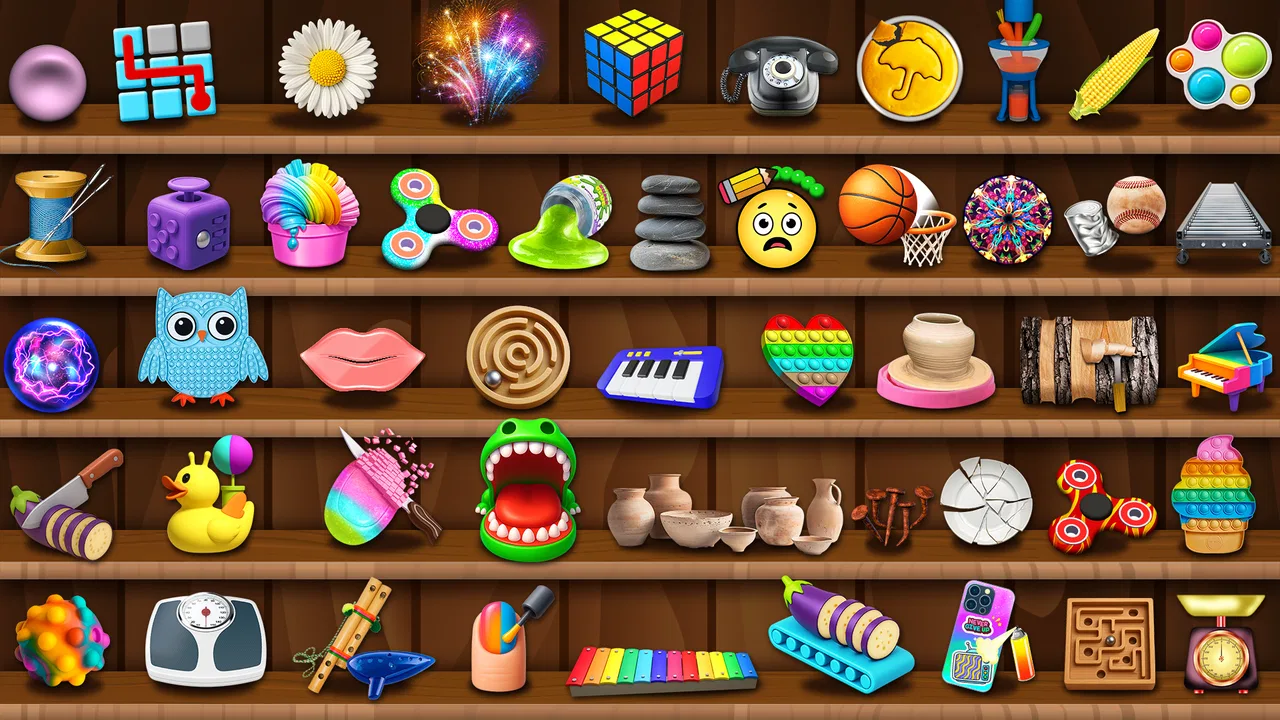
Antistress Relaxing Mini Games
- 4.4
- Rating
- 5.00M
- Installs
- Free
- Price

 Analysis by App-foxy
I opened Antistress Relaxing Mini Games expecting a quick collection of simple distractions, and that is exactly where its appeal begins. It is a casual game from CAT Studio built around small activities intended to help me slow down for a moment rather than chase a demanding score. The presentation is easy to understand, the age rating is Everyone, and the free entry makes it simple to try without treating the game like a major commitment.
My first sessions felt best when I used it in short gaps: after finishing a task, while waiting for an appointment, or when I wanted something more active than staring at a blank screen but less demanding than a full game. The emphasis is on mini antistress activities, pop-it-style interaction, and ASMR-inspired play. That combination gives the app a clear mood, although it also means the experience depends heavily on whether you enjoy repetitive, gentle interactions.
The game has reached over a million installs and holds a 4.5 average from around fourteen thousand ratings. Those figures suggest that the basic idea connects with a broad audience, but they should not be mistaken for proof that every activity will suit every player. I found the most value in treating it as a small relaxation tool, not as a deep casual game with long-term progression.
You May Also Like

 Google Keep - Notes and lists
Google Keep’s Quiet Growth Shows the Appeal of Simpler Notes
As mobile work gets busier, Google Keep keeps winning a simple contest: capture a thought quickly, find it later, and get on with the day.

 Blood Strike: 2.5 Anniversary
Blood Strike’s Loadouts Turn Every Drop Into a Tactical Gamble
A close look at Blood Strike’s custom loadouts: how fast access to signature weapons reshapes its battle royale rhythm, rewards preparation, and narrows the gap between fights.

 Pandora - Music & Podcasts
Pandora’s Music Is Easy to Start, but Harder to Recover
Pandora’s strength is its low-effort path from a seed to a station. Its weak spot is how much confidence it asks you to place in connection, setup, and quiet recovery.

 8 Ball Pool
 Is Built on Rivalries, Rematches, and Routine
A close look at the rivalries, rematches, shared routines, and unanswered safety questions that turn a quick pool match into a persistent mobile community.

 Samsung Music
’s Quiet Strength Is Playing What You Already Own
Its reach comes less from spectacle than from dependable access to a personal library. That simplicity is both the app’s strongest retention engine and its ceiling.

 AccuWeather: Weather Radar
AccuWeather Review: A Quick, Clear Forecast for Everyday Decisions
For everyday plans, the best forecast is the one you can understand quickly. AccuWeather makes rain timing, radar, and local conditions easy to act on, with a few trade-offs.
More From Our News Desk



A small game designed around a softer kind of attention
The overall setting is not built around characters, story missions, or a large fictional world. Instead, the world language comes from the objects and interactions themselves. A pop-it toy, a tactile button, or a simple ASMR-like action becomes the scene. That is a smart choice for this type of product because it keeps the mental load low. I do not need to remember a plot, learn a complicated control system, or prepare for an opponent.
This also gives the game a coherent identity. The individual activities may differ in what I do with my fingers, but they are connected by the same promise: take a small action, receive a satisfying response, and move on when the moment feels complete. The design works best when I stop looking for a traditional objective and pay attention to the sensation of the interaction.
That approach will appeal to people who like digital versions of familiar stress-relief objects. It may also work for younger players who want something approachable, since the Everyone rating matches the uncomplicated nature of the experience. I would still guide a child toward short sessions, especially because a calming game can easily become another reason to keep looking at a screen.
What I appreciate is the lack of pressure in the basic concept. Many casual games use simple controls but surround them with timers, rewards, streaks, or constant prompts to continue. Here, the central attraction is the activity itself. When it works, I can enter, play for a few minutes, and leave without feeling that I have abandoned a task.
There is a trade-off, though. Players who need a strong sense of achievement may find the setting too light. The absence of a substantial story or competitive purpose is not a flaw for someone seeking relaxation, but it becomes a limitation if you want unlockable goals, strategic variety, or a reason to return every day beyond the mood of the moment.
How the visual language supports the mood
The art direction is most effective when it stays readable and uncluttered. For a tactile mini-game collection, clear shapes and immediate visual responses matter more than elaborate scenery. I never want to spend the first minute figuring out what can be touched. The visual language needs to point toward the next action without making me feel tested, and this game’s concept is strongest when it does that.
The pop-it influence is especially important because it gives the experience a familiar physical reference. Pressing virtual elements is not the same as handling silicone or plastic in real life, but the visual suggestion helps establish the expected rhythm. I know what kind of response I am looking for before I begin, which makes the interaction feel accessible rather than mysterious.
One useful way to play is to choose an activity based on the kind of attention I have available. If I am mentally tired, I prefer the most obvious interaction, where the next touch is easy to understand. If I am restless, a slightly more involved mini-game can give my hands something to do without demanding the concentration of a puzzle or action title.
This is also where the game compares favorably with ordinary casual alternatives. A match-three game or endless runner may look simple, but both usually ask me to optimize, react quickly, or think ahead. A relaxation-focused mini-game can be better when I want to interrupt a thought loop rather than replace it with another challenge.
On the other hand, a physical fidget toy remains better for anyone who wants relief without a display. A meditation app may be a stronger choice for guided breathing or structured mindfulness. This game occupies the middle ground: it gives my hands a low-effort activity and uses a screen to make that activity immediately available.
Sound, repetition, and the pace of a short session
The audio direction matters more here than it would in many other casual games. In an action title, sound effects can simply confirm a hit or warn me about danger. In an antistress game, the sound is part of the reward. A soft, well-timed response can make a repeated action feel deliberate; an irritating or overly sharp response can destroy the mood almost instantly.
I found the best rhythm comes from keeping the interaction unhurried. The game’s premise does not need rapid tapping, and rushing works against the reason to open it. I like to make a few actions, notice the response, and pause instead of treating every mini-game as something to finish as quickly as possible. That small change makes the experience feel more like a reset than a conventional round.
This is one of the less obvious practical tips I would give a new player: do not judge the game after a frantic first minute. Try it when you can lower your pace, and use the simplest activity first. The calming effect depends partly on how I approach the controls. If I turn the session into a race, I bring the same tension I was trying to escape.
Another useful habit is to decide in advance how long the session should last. Because the activities are easy to start, it is tempting to continue automatically. A short personal limit keeps the game in its intended role and prevents a relaxing break from becoming an unplanned block of screen time. This is particularly relevant for children or anyone who is trying to reduce phone use.
The audio-and-rhythm approach also separates this title from ordinary idle games. Idle games often create a background loop around accumulation, upgrades, and waiting. Here, the reward is more immediate and sensory. That can feel refreshing when I do not want numbers to manage, but it also means there is less reason to return once the novelty of a particular interaction fades.
Where the mechanics fit and where they fall short
The mechanics are intentionally approachable. I do not need a long tutorial to understand the basic idea, and the activities are suited to quick touch-based play. That makes the game a good companion for short breaks, especially when I want something more engaging than a passive video but cannot commit to a full session of a larger title.
The strongest mechanical fit comes from the connection between action and response. When the game lets me perform a small gesture and immediately see or hear its result, the interaction feels complete. There is no need for a complicated reward structure to justify every touch. For stress relief, that directness is more important than depth.
Still, simple mechanics have a limited ceiling. If I am looking for precise challenges, character development, tactical decisions, or a long campaign, this is not the right destination. The game can occupy my hands, but it is not designed to occupy my entire evening. I would choose a puzzle game when I want to solve something, a rhythm game when I want performance pressure, and this one when I want the pressure removed.
The current version is 0.0.5, so I approach it as an early-stage experience rather than a finished-feeling platform that must satisfy every type of player. That version number is relevant when setting expectations: the collection may feel more like a focused relaxation toy than a huge library of polished systems. I would recommend trying the free version first and deciding whether the available interactions offer enough variety for your routine.
There are also practical trade-offs around spending. The game is free, with in-app purchases priced at $1.99 per item. I would not buy anything immediately. First, I would identify which activities I actually return to and whether the free experience already covers the moments when I need it. For this kind of app, a purchase only makes sense if it improves a repeated habit rather than simply extending a first-session curiosity.
A good workflow is to use it in three distinct situations: a brief pause between work blocks, a wind-down period when I want light finger activity, and a reset after an irritating conversation or task. In each case, I would select one mini-game, avoid switching constantly, and stop when I feel less keyed up. Constantly browsing for the perfect activity can become its own form of stimulation.
That workflow reveals both a strength and a weakness. The strength is flexibility: I can make the experience as short as I need. The weakness is that the game does not necessarily provide a structured path from tension to calm. If I need guided breathing, sleep preparation, or a carefully staged relaxation program, a dedicated wellness app is likely to be more useful.
Who will enjoy it most
I would recommend this game to people who like tactile digital toys, gentle ASMR-style interactions, and casual activities that can be understood immediately. It is particularly suitable for someone who wants a small break without entering a competitive game loop. The free price makes experimentation easy, and the Everyone rating makes the concept broadly approachable.
It also suits players who dislike losing. There is a difference between a game that is easy and a game that does not make failure central. Here, the appeal is not proving skill against an opponent. That can be comforting after a demanding day, when even a harmless challenge feels like another obligation.
I would be more cautious recommending it to someone who needs a reliable treatment for serious anxiety or persistent stress. A mini-game can provide a momentary distraction, but it is not a substitute for professional support, sleep, movement, conversation, or a structured mental-health routine. Its role is smaller and more practical: give attention a gentle place to land for a few minutes.
I would also skip it if I already know that repetitive tapping irritates me, or if I prefer games with a clear long-term objective. The same simplicity that makes the app welcoming can make it feel thin. Players who enjoy collecting, upgrading, competing, or discovering a detailed world will probably get more satisfaction from another casual category.
For parents, the game’s age classification is reassuring in terms of its broad audience, but I would still treat it as screen entertainment rather than automatically healthy screen time. Setting a simple stopping point is more useful than assuming that a calming theme removes all concerns about extended device use.
My final view of the atmosphere
What stays with me is the way the art direction, sound-led feedback, and slow pacing support one another. The game is not trying to disguise a complex system behind a relaxing label. Its mechanics are small because the intended mood is small: a few minutes of low-pressure interaction that can interrupt a busy mental rhythm.
That coherence is its main success. The pop-it and ASMR-inspired ideas give the experience a recognizable sensory identity, while the casual structure keeps the barrier to entry low. I can recommend it to a friend who wants a digital fidget break, provided I explain that the value comes from the moment-to-moment feel rather than a deep catalogue of goals.
My honest reservation is longevity. I can imagine returning regularly when I need a quick reset, but I would not expect the same level of interest from someone seeking a main game. The limited-pressure design is excellent for short use and less convincing as an all-purpose entertainment product. That is not a contradiction; it is the central trade-off.
CAT Studio has made a focused free game for a specific emotional use case. With its 4.5 average and more than a million installs, it has clearly found an audience, but my recommendation is still personal rather than automatic. Choose it when you want your hands occupied without your mind being challenged. If that sounds like the kind of break you need, this is an easy, friendly option to try. If you want progression, competition, guided relaxation, or a richer world, another app will serve you better.
FAQs for Antistress Relaxing Mini Games
01What types of mini games are included in Antistress Relaxing Mini Games?
Antistress Relaxing Mini Games offers a diverse collection of mini games designed to help you unwind and relax. These include activities like coloring, puzzle solving, fidget spinners, and virtual bubble wrap popping. Each game is crafted to provide a soothing experience, helping you relieve stress and anxiety.
02Is Antistress Relaxing Mini Games suitable for all ages?
Yes, Antistress Relaxing Mini Games is designed to be suitable for all age groups. The games are simple, intuitive, and free from any inappropriate content, making them perfect for both children and adults. It’s a great choice for anyone looking to find a peaceful escape from daily stressors.
03Do I need an internet connection to play the games?
No, you do not need an active internet connection to enjoy Antistress Relaxing Mini Games. Once downloaded, you can access and play all the games offline. This makes it a convenient option for relaxation on the go, whether you're traveling or simply without access to Wi-Fi.
04Are there any in-app purchases or ads?
Antistress Relaxing Mini Games may include some in-app purchases and advertisements. These are typically used to unlock additional content or disable ads. However, the basic version provides plenty of free content that offers a satisfying and relaxing experience without any purchases.
05How often are new games or features added to the app?
The developers of Antistress Relaxing Mini Games frequently update the app with new games and features to enhance user experience. Updates usually include bug fixes, additional content, and improvements based on user feedback, ensuring a continually fresh and engaging experience.
Pros
- Wide variety of relaxing games.
- Simple
- intuitive interface.
- No internet needed for most games.
- Frequent updates with new content.
- Minimal ads for a smooth experience.
Cons
- Limited depth in some games.
- Not all games are unlocked initially.
- Lacks multiplayer options.
- Graphics are very basic.
- Some games can be repetitive.

Antistress Relaxing Mini Games
Gallery